What US bases did Iran target? Were any Americans killed?

No American servicemembers were killed or wounded in awave of attacksIran launched at U.S. bases across the Middle East in retaliation for the U.S.-Israeli missile strikes on the country on Feb. 28, the U.S. military announced hours later.

USA TODAY

The military "successfully defended" against hundreds of Iranian missiles and drones, and there were "no reports of U.S. casualties or combat-related injuries," U.S. Central Command said in a Feb. 28statementposted to X. "Damage to U.S. installations was minimal and has not impacted operations," the statement said.

There are between 30,000 and 40,000 U.S. troops in the region on any given day, Capt. Tim Hawkins, a spokesperson for Central Command,previously told USA TODAY.

A service center for the U.S. Navy's 5th Fleet, which is headquartered in Bahrain, wasattackedwith missiles, according to the country's communication center.Videoverified by multiple news outlets showed the moment a missile struck near the naval base, leaving a billowing cloud of smoke.

The United States attacked Iran roughly an hour after midnight on Feb. 28, hitting targets to "dismantle the Iranian regime's security apparatus," including the command and control facilities for its Revolutionary Guard Corps, "air defense capabilities, missile and drone launch sites, and military airfields," according to the statement.

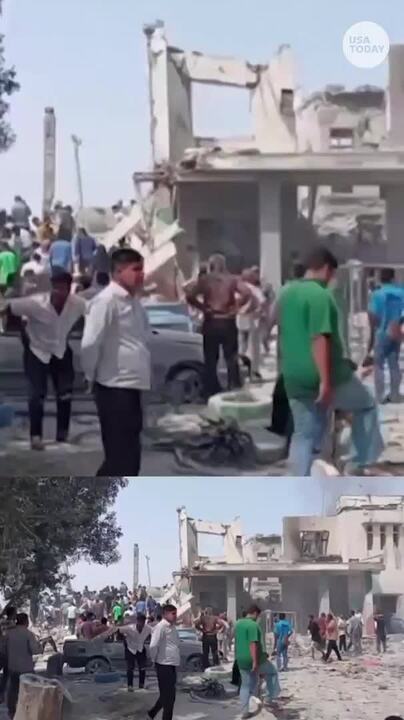
<p style=This picture obtained from Iran's ISNA news agency shows the site of a strike on a girls' school in Minab, in Iran's southern Hormozgan province, on February 28, 2026. The strike killed 85 people, according to Iranian media and officials.

According to President Donald Trump, the United States joined Israel in launching military strikes, as well as "major combat operations," to target Iran's missile capabilities. Supreme Leader Ayatollah Ali Khamenei was killed in the joint strikes with Israel on Iran, an Israeli source confirmed to USA TODAY. Trump also confirmed on Truth Social that the leader had been killed.

" style="max-width:100%; height:auto; border-radius:6px; margin:10px 0;" loading="lazy" /> People and rescue forces work following an Israel strike on a school in Minab, Iran, February 28, 2026. People and rescue forces work following an Israel strike on a school in Minab, Iran, February 28, 2026. People and rescue forces work following an Israel strike on a school in Minab, Iran, February 28, 2026. Black smoke rises from a destroyed building at a school where, as the state media reports, several people were killed in an Israeli airstrike, following strikes by the United States and Israel against Iran, in Minab, Iran in this screengrab obtained from a social media video released on February 28, 2026. This picture obtained from Iran's ISNA news agency shows the site of a strike on a girls' school in Minab, in Iran's southern Hormozgan province, on February 28, 2026. The United States and Israel launched strikes against Iran on February 28, with Israel's public broadcaster reporting that supreme leader Ayatollah Ali Khamenei had been targeted, as the Islamic republic retaliated with barrages of missiles at Gulf states and Israel. This picture obtained from Iran's ISNA news agency shows the site of a strike on a girls' school in Minab, in Iran's southern Hormozgan province, on February 28, 2026. The United States and Israel launched strikes against Iran on February 28, with Israel's public broadcaster reporting that supreme leader Ayatollah Ali Khamenei had been targeted, as the Islamic republic retaliated with barrages of missiles at Gulf states and Israel. This picture obtained from Iran's ISNA news agency shows the site of a strike on a girls' school in Minab, in Iran's southern Hormozgan province, on February 28, 2026. The United States and Israel launched strikes against Iran on February 28, with Israel's public broadcaster reporting that supreme leader Ayatollah Ali Khamenei had been targeted, as the Islamic republic retaliated with barrages of missiles at Gulf states and Israel. People gather at the site of a destroyed building at a school where, as the state media reports, several people were killed in an Israeli airstrike, following strikes by the United States and Israel against Iran, in Minab, Iran in this screengrab obtained from a social media video released on February 28, 2026. People gather at the site of a destroyed building at a school where, as the state media reports, several people were killed in an Israeli airstrike, following strikes by the United States and Israel against Iran, in Minab, Iran in this screengrab obtained from a social media video released on February 28, 2026. A view shows the aftermath of an Israel strike on a school in Minab, Iran, February 28, 2026.

85 killed at girls' school in Iran amid US-Israeli strikes, state media reports

This picture obtained from Iran's ISNA news agency shows the site ofa strike on a girls' school in Minab, in Iran's southern Hormozgan province, on February 28, 2026. The strike killed 85 people, according to Iranian media and officials.According toPresident Donald Trump, the United States joined Israel inlaunching military strikes, as well as "major combat operations," to target Iran's missile capabilities. Supreme Leader Ayatollah Ali Khamenei was killed in the joint strikes with Israel on Iran, an Israeli source confirmed to USA TODAY. Trump also confirmed on Truth Social that the leader had been killed.

PresidentDonald Trumphas for monthsthreatened to attack Irana second time, ordering the largest buildup of U.S. troops and military assets in the region since the Iraq War began more than a decade ago. The U.S. military previously dropped penetrating bombs on Iranian nuclear facilities in June.

Advertisement

In the aftermath of the U.S. attack, Iran launched attacks at U.S. allies where American troops are stationed across the region, including Kuwait, Saudi Arabia, Bahrain, Jordan, Qatar and the United Arab Emirates. Videos posted to social media and media outlets showed missiles smashing into urban areas and high0rise buildings.

Video showed smoke rise near a U.S. Navy base in Bahrain after an Iranian missile struck on Feb. 28.

Videos on X also showed a missile taken down over Al Udeid Air Base in Qatar, the forward headquarters for U.S. Central Command. Qatar's Defense Ministrysaidmissiles fired at the base were intercepted.

Three members of Kuwait's armed forces suffered minor injuries from falling shrapnel after Ali Al-Salem Air Base, whichhoststhe 386th Air Expeditionary Wing, came under attack, according to the country'sdefense ministry.

Erbil, a city in Iraq that is home to a U.S. air base, was also hit by missiles, the Iraqi government said in astatement. Witnesses in Al Dhafra, the site of a U.S. air base south of the Emirati capital of Abu Dhabi, also heard explosions, Reutersreported.

Jordan, the home of Muwaffaq al Salti Air Base, which hosts the Air Force's 332nd Air Expeditionary Wing, also intercepted missiles, according to newsreports.

The same could not be said in Iran. According to state media, more than 200 people were killed and more than 700 injured across Iran in the attack, including40 at a girls' schoolin the country's south.

This article originally appeared on USA TODAY:What US bases did Iran target? Were any Americans killed?

What US bases did Iran target? Were any Americans killed?

No American servicemembers were killed or wounded in awave of attacksIran launched at U.S. bases across the Middle East i...
US and Israel clash with Iran at emergency Security Council meeting. UN chief condemns attacks

UNITED NATIONS (AP) — The United States and Israel clashed with Iran at an emergency meeting of the U.N. Security Council on Saturday where the U.N. chief and many countries urged a halt totheir attacksand a return to negotiations to prevent the conflict from spreading further into the region and beyond.

Associated Press

Secretary-General António Guterres told the council that everything must be done to prevent an escalation. "The alternative," he warned, "is a potential wider conflict with grave consequences for civilians and regional stability."

Guterres said the U.S. and Israeli airstrikes violated international law, including the U.N. Charter. He also condemned Iran's retaliatory attacks for violating the sovereignty and territorial integrity of Bahrain, Iraq, Jordan, Kuwait, Qatar, Saudi Arabia and the United Arab Emirates.

The U.S. ambassador to the United Nations, Mike Waltz, insisted the U.S. military action was lawful.

"Iran cannot have a nuclear weapon," he told the council. "That principle is not a matter of politics. It's a matter of global security. And to that end, the United States is taking lawful actions."

Israel's U.N. Ambassador Danny Danon defended the airstrikes as necessary to stop an existential threat.

"We are stopping extremism before it becomes unstoppable," he said. "We will ensure that no radical regime armed with nuclear weapons and ballistic missiles can threaten our people or the entire world."

Amir Saeid Iravani, Iran's ambassador to the U.N., told the council that the airstrikes have killed and injured hundreds of Iranian civilians, which he called a war crime and a crime against humanity.

He blasted the U.N. and the Security Council, its most powerful body, for not heeding Tehran's warnings about the "warmongering statements" by the U.S. in recent weeks and urged the council to act now.

"The issue before the council is straightforward: whether any member state may, including a permanent member of this council, through the use of force, coercion or aggression, determine the political future or system of another state or impose control over its affairs," Iravani said.

During his speech, the Iranian diplomat did not mention or comment on President Donald Trump's statement that Supreme Leader AyatollahAli Khameneiwas killed in the strikes. The assassination of the second leader of the Islamic Republic, who had no designated successor, raised the prospects of a protracted conflict given Iranian threats of retaliation.

Iranian and US ambassadors have tense back-and-forth

In a rare exchange, the U.S. and Iranian ambassadors traded warnings and direct rebuffs toward the end of the emergency session as military aggression between their countries risked spilling into a regional war.

Advertisement

After Waltz responded to Iranian claims that the U.S. had violated international law, Iravani asked to speak again to issue a warning: "I advise to the representative of the United States to be polite. It will be better for yourself and the country you represent."

Waltz responded immediately, saying, "This representative sits here, in this body, representing a regime that has killed tens of thousands of its own people, and imprisoned many more, simply for wanting freedom from your entire tyranny."

Other Security Council members speak up

Russia's ambassador condemned the U.S.-Israeli airstrikes, while China's ambassador was more measured in his criticism.

"We demand that the United States and Israel immediately cease their aggressive actions," Russian U.N. Ambassador Vassily Nebenzia said. "We insist on the immediate resumption of political and diplomatic settlement efforts … based on international law, mutual respect and a balance of interests."

China's U.N. Ambassador Fu Cong said China was very concerned by "the sudden escalation of regional tensions" and supported Russia's call for a return to diplomatic negotiations.

The permanent observer of the 22-nation Arab League, Maged Abdelaziz, suggested Israel was being hypocritical in justifying its military attack by saying it was intended to prevent Iran from acquiring nuclear weapons. Abdelaziz, a former Egyptian ambassador to the U.N., noted that Israel has refused to subject its own nuclear facilities to inspection by the U.N. nuclear watchdog.

The emergency meeting was called by five council members: Bahrain, which is the Arab representative on the council, France, Russia, China and Colombia,.

In a joint statement, the leaders of Britain and France — both veto-wielding members of the council — along with Germany's chancellor called for a resumption of U.S.-Iranian talks on Tehran's nuclear program. The three countries, part of the 2015 nuclear deal with Iran, have led efforts to reach a negotiated solution. Trump pulled the U.S. out of the deal in 2018.

The three European leaders strongly condemned Iranian airstrikes in the region — not the U.S.-Israeli airstrikes — and urged Iran's leaders to seek a negotiated solution, saying: "Ultimately, the Iranian people must be allowed to determine their future."

The Security Council meeting is taking place on the last day of the United Kingdom's presidency and a day before the United States takes over the rotating presidency for the month of March.

Amiri reported from Atlanta.

US and Israel clash with Iran at emergency Security Council meeting. UN chief condemns attacks

UNITED NATIONS (AP) — The United States and Israel clashed with Iran at an emergency meeting of the U.N. Security Council...
Iran's foreign minister says he's unsure why U.S. attacked during nuclear talks

Changing theIranian regimeis "mission impossible," the country's foreign minister told NBC News, hours after the U.S. andIsrael launched a major attack on the Islamic RepublicandPresident Donald Trumpcalled on its citizens to overthrow their leaders.

NBC Universal

"You cannot do regime change while millions of people are supporting the so-called regime," Abbas Araghchi said in an interview from the capital Tehran.

On Thursday, a team of Iranian negotiators were talking with U.S. special envoys Steve Witkoff and Jared Kushner, Trump's son-in-law, in Geneva with the aim of averting a potential military assault, "and a deal was at our reach," Araghchi said.

"We were able to address serious questions related to Iran's nuclear program. We obviously have differences, but we resolved some of those differences, and we decided to continue in order to resolve the rest of questions," he said, adding he didn't know why while the talks were progressing "they decided to attack us."

Other senior officials in the regime had survived, Araghchi said, including President Masoud Pezeshkian, the head of the judiciary and the parliament speaker. Two commanders were killed.

He also said that "as far as I know," the supreme leader,Ayatollah Ali Khamenei, is alive, although Trump later said he had been killed. Iran has no confirmed if he is dead.

The strikes, during the holy Muslim fasting month of Ramadan, came weeks after a U.S.military operation that captured Venezuelan President Nicolás Maduro and his wife, Cilia Flores,and brought them to New York to face federal drug conspiracy charges.

It also marked the second time in eight months that theTrump administration has used military forceagainst the Islamic Republic.

In a video announcing the "major combat operations," Trump told Iranians to "take over your government" when the U.S. was finished. "It will be yours to take," he said. "This will be probably your only chance for generations."

His comments were echoed byIsraeli Prime Minister Benjamin Netanyahu, who said the operation would "create the conditions for the brave Iranian people to take their fate into their own hands."

But Araghchi said it was not possible to spark regime change because Iran's government was "supported by the people."

Unprecedented nationwide unrest last month saw authorities in Iran launch a deadly crackdown.

Advertisement

The U.S.-based Human Rights Activists News Agency has said it confirmed more than 7,000 deaths and that it is investigating thousands more. The group says that it verifies each death with a network of activists on the ground in Iran and that its data goes through "multiple internal checks."

Iran's government has acknowledged more than 3,000 people were killed.

"Yes, there are also people who are complaining, but there are strong supporters of the regime," said Araghchi. "And then we have a very well-established political structure."

Millions of people came out onto the streets in cities across the country to mark the recent anniversary of the 1979 revolution, Araghchi noted.

He added that the U.S. and others had tried and failed to do this in the past, so if they want to repeat a failed experience, "they won't get any better result."

While there was "no communication right now" with the U.S., Araghchi said, Tehran was interested in de-escalation and ready to talk once the joint U.S.-Israeli strikes end.

Iran was "certainly interested for de-escalation," and American negotiators could contact him if they wanted to resume talks, he said. "This is a war of choice by the United States, and they have to pay for that," he added. "But as far as we are concerned, we don't want war."

Disputing Trump's claim in hisState of the Union addressthat the Islamic Republic is building missiles capable of hitting the U.S., Araghchi said Iran had no desire to do so and had intentionally restricted the range of its missiles.

"We don't want to do that because we don't have any hostility against, you know, the United States people," he said. Iran, he added, had built weapons "in order to defend ourselves against our enemies."

American forces were attacking our people in our cities, he said, "but this is not what we are going to do. We are attacking the Americans bases, military bases in the region, and military installations and facilities, and this is only as an act of self-defense."

He also referenced what Iran says was a deadly strike on a school in the southern city of Minab. Dozens were killed in the incident, local officials have said.

In an earlier post on X, he shared a photo of dozens of people surrounding a heavily damaged building with smoke rising from the facility, which he said was "bombed in broad daylight, when packed with young pupils."

Iran's foreign minister says he's unsure why U.S. attacked during nuclear talks

Changing theIranian regimeis "mission impossible," the country's foreign minister told NBC News, hours afte...
Iranian Americans divided in reactions to US attacks

Corrections and clarifications: This story was updated to clarify the National Iranian American Council's mission.

USA TODAY

Ongoing military strikes in Iran have highlighted deep chasms between Iranian Americans seeking to overthrow the country's oppressive government and others who wanted a peaceful resolution through negotiations.

The United States and Israellaunched military strikesand "major combat operations" against Iran on Feb. 28, PresidentDonald Trumpsaid, targeting the country's missile capabilities. The attack follows weeks of negotiations over Iran's nuclear and missile development programs.

"Our objective is to defend the American people by eliminating imminent threats from the Iranian regime, a vicious group of very hard, terrible people," Trump said, calling the strikes"a massive and ongoing operation."

<p style=Iran launched retaliatory drone and missile strikes against American and Israeli targets after the joint U.S.-Israeli attack. Iran said its enemies would be "decisively defeated." Photos show reported attacks in Bahrain and Qatar.

Smoke rises after the state news agency reported missile attack on the service center of the U.S. Fifth Fleet, following strikes by the United States and Israel against Iran, in Manama, Bahrain February 28, 2026, in this still image obtained from a video.

" style="max-width:100%; height:auto; border-radius:6px; margin:10px 0;" loading="lazy" /> Smoke rises during a reported Iranian missile attack near a U.S. base, following strikes by the United States and Israel against Iran, in Manama, Bahrain, in this screengrab obtained from a video released on February 28, 2026. Smoke wafts in the distance after missiles were fired over Qatar on February 28, 2026 in Doha, Qatar. Iran launched a wave of missiles against Israel and U.S. military sites in the wider region after a joint U.S.-Israeli attack on multiple locations across Iran this morning. The U.S. maintains a significant military presence at Al Udeid Air Base in Qatar. Smoke from an apparent missile interception hangs in the air on February 28, 2026 in Doha, Qatar. Iran launched a wave of missiles against Israel and U.S. military sites in the wider region after a joint U.S.-Israeli attack on multiple locations across Iran this morning. The U.S. maintains a significant military presence at Al Udeid Air Base in Qatar. Smoke rises from an area in the direction of Al Udeid Air Base, which houses the Qatar Emiri Air Force and foreign forces including the US, in Doha on February 28, 2026, following a reported Iranian strike. The United States and Israel launched strikes against Iran on February 28, with Israel's public broadcaster reporting that supreme leader Ayatollah Ali Khamenei had been targeted, as the Islamic republic retaliated with barrages of missiles at Gulf states and Israel. Smoke from an apparent missile interception on February 28, 2026 in Doha, Qatar. Iran launched a wave of missiles against Israel and U.S. military sites in the wider region after a joint U.S.-Israeli attack on multiple locations across Iran this morning. The U.S. maintains a significant military presence at Al Udeid Air Base in Qatar. Smoke from an apparent missile interception on February 28, 2026 in Doha, Qatar. Iran launched a wave of missiles against Israel and U.S. military sites in the wider region after a joint U.S.-Israeli attack on multiple locations across Iran this morning. The U.S. maintains a significant military presence at Al Udeid Air Base in Qatar. Smoke rises during a reported Iranian missile attack near a U.S. base, following strikes by the United States and Israel against Iran, in Manama, Bahrain, in this screengrab obtained from a video released on February 28, 2026. Smoke rises after the state news agency reported missile attack on the service center of the U.S. Fifth Fleet, following strikes by the United States and Israel against Iran, in Manama, Bahrain February 28, 2026 in this still image obtained from a video.

See Iran's retaliatory attacks on US military sites in the Middle East

Iran launchedretaliatory drone and missile strikesagainst American and Israeli targets after the joint U.S.-Israeli attack. Iran said its enemies would be "decisively defeated." Photos show reported attacks in Bahrain and Qatar.Smoke rises after the state news agency reported missile attack on the service center of the U.S. Fifth Fleet, following strikes by the United States and Israel against Iran, in Manama, Bahrain February 28, 2026, in this still image obtained from a video.

GOP Rep. Stephanie Bice of Oklahoma, the first Iranian American elected to Congress, saidon social media, "now is the time for Iranians to stand up and take back their nation and bring lasting peace to the Middle East."

Updates:Iran hit by 'massive' US attack; supreme leader targeted

Arizona Rep. Yassamin Ansari, the first Iranian American Democrat elected to Congress, said in a statement she is balancing her family history with her responsibility as a member of Congress. She said plans to support the War Powers Resolution that House Democrats intend to force to the floor next week. Her family fled the regime.

"Donald Trumphas specifically said Americans and innocent Iranians will die in this conflict, yet he has not shared a real, comprehensive plan with Congress or a justification with the American people," she said. "I want a free Iran and a future of democracy and dignity for the Iranian people. I also want American troops to be safe. Those goals must be part of a coherent strategy that does not risk chaos or another endless war in the Middle East and require seriousness and leadership equal to the stakes."

More than one-thirdof the nearly 400,000 Iranian immigrants in the United States are in the Los Angeles area, and more than half live in California. Many fled Iran after the 1979 revolution.

Los Angeles City Councilman Adrin Nazarian, a Democrat, fled Iran when he was 8 years old in 1981 with his family, who areChristian Armenians, a minority in Iran that have faced discrimination. Now 52, he said there are mixed emotions with strikes.

"I want to see the ouster of this regime, but at the same time, I feel there is a price that's really being paid is by the residents of Iran," he told USA TODAY. Instead, he said changes need to come from within Iran, not through attacks from outside.

Advertisement

Prominent Iranian and Muslim organizations outraged

People display a banner as they attend a protest against U.S. and Israel strikes against Iran, during a rally in Times Square, in Manhattan, New York City, on February 28, 2026.

The United States shouldn't have acted whilediplomatic negotiations were still underway, said Jamal Abdi, president of the National Iranian American Council (NIAC), a Washington, DC-based organization that advocates for diplomacy and improving American relations with Iran.

"We are outraged by the decision to launch military strikes on Iran, at the very moment diplomacy was active and reportedly making progress," Abdi said in a statement. "There has been no evidence of imminent attack from Iran that would justify bombing Tehran in broad daylight."

More:Dozens killed at girls' school in Iran amid US-Israeli strikes, state media reports

The Council on American-Islamic Relations, the nation's largest Muslim civil rights and advocacy organization, encouraged Americans to contact the White House and their members of Congress to demand an end to the Trump administration's "unnecessary, unjustified, and unconstitutional" strikes against Iran "for Israel's benefit."

"The Trump administration has completed its transformation into the Bush administration by starting another unnecessary, unjustified and unconstitutional regime-change war in the Middle East under pressure from the Israeli government and its supporters," the CAIR statement said.

Reza Pahlavi, former shah's son, praises strikes

Reza Pahlavi, the exiled son of the last shah of Iran, speaks during a press conference in Paris, France, on June 23, 2025.

Reza Pahlavi, the son of Iran's last shah who lives in the United States, praised the strikes as "a humanitarian intervention."

"Its target is the Islamic Republic, its apparatus of repression, and its machinery of killing − not the country and great nation of Iran," Pahlavi saidin a social media post.

Pahlavi has positioned himself as a leader in the West opposing Iran's Islamic Republic government. The country's current government came to power after overthrowing his father's Imperial State of Iran, which ruled Iran for decades, including centralizing power in1953 during a U.S.-backed coupthat toppled a democratically elected leader.

Pahlavi stressed that the people of Iran must be the ones to overthrow the government.Recent protests in Iranagainst the government have resulted in harsh crackdowns, withthousands of demonstrators killed by security forces.

"Despite the arrival of this assistance, the final victory will still be achieved by us. It is we, the people of Iran, who will finish this task in this final battle. The time to return to the streets is approaching," Pahlavi said.

He urged people to stay home for now and said he would communicate when it was time "for the final action."

This article originally appeared on USA TODAY:Iranian Americans react to US and Israeli attacks

Iranian Americans divided in reactions to US attacks

Corrections and clarifications: This story was updated to clarify the National Iranian American Council's mission. ...
Columbia says ICE agents used false pretenses to enter a university residence and detain a student. Here's what we know

Ellie Aghayevaspent Wednesday night buried in books at a Columbia University library, documenting an intense 10-hour study session for her social media following — a window into the discipline and determination of student life.

CNN Protesters hold an anti-ICE rally outside Columbia University after federal agents detained a student Thursday. - Mostafa Bassim/Anadolu/Getty Images

Little did she know at the time, she would spend roughly the same number of hours in federal immigration detention the next day.

Aghayeva, a senior at the university, was taken into custody by agents from the Department of Homeland Security at a Columbia-owned residential building in New York City at about 6:30 a.m. Thursday, university officials said. About nine hours later, she posted on her Instagram account she had been released.

University officials claimed the agents misrepresented their purpose in order to access the building, entering "without any kind of warrant" and using the false pretense of searching for a missing child. DHS said it was targeting Aghayeva because she is an undocumented immigrant "whose student visa was terminated in 2016 under the Obama administration for failing to attend classes."

New York Mayor Zohran Mamdani raised Aghayeva's detention with President Donald Trump during a meeting at the White House Thursday, saying shortly after that Trump had informed him she would be released.

Aghayeva sued federal officials while she was detained on Thursday, according to court records.

In response to the federal habeas corpus petition, a judge set a hearing for next Friday at the Thurgood Marshall United States Courthouse in New York.

Habeas corpusis a legal principlethat allows someone who believes they are being held unlawfully to ask a court to review their detention and order their release if warranted.

US District Court Judge Katherine Polk Failla ordered Aghayeva to not be removed from the country or transferred to a detention facility outside New York or New Jersey without a court order.

Failla's order was filed around the same time as Aghayeva was released, after Mamdani discussed her case with Trump.

As uncertainty shrouds the circumstances of her detainment, here's what we do and don't know about the case:

Who is Ellie Aghayeva?

Aghayeva is an international student from Azerbaijan, double majoring in neuroscience and political science, according to the American Association of University Professors.

Aghayeva has more than 200,000 followers combined on her Instagram and TikTok accounts, where she consistently posts on a variety of topics from marathon library study sessions to her daily routines and productivity tips.

Aghayeva shared news of her detention on Instagram Thursday, showing a photo of just her legs with the caption: "DHS illegally arrested me. Please help." The post was deleted after her release.

Columbia University student Ellie Aghayeva was detained Thursday. - ellharve/Instagram

Aghayeva later shared on Instagram she had been released, saying she was "safe and okay" and on her way home. "I am in complete shock over what happened … I need a little bit of time to process everything I will come back soon. But please don't worry," she wrote.

A friend of Aghayeva, Sabah Bari, described her as a "highly motivated" and "extremely intelligent" person who is involved in student organizations, academically accomplished and "very funny."

Aghayeva is on track to graduate in May, said Bari, a student at Columbia's Mailman School of Public Health.

On social media, Aghayeva offers a glimpse into her world, blending library study sessions with motivational messages and hints of her immigrant journey. "As long as I am alive, I can begin again … There is no end. No finish line," she wrote on one video.

Other posts honor her family: "Studying is hard but my parents sacrificed everything across the ocean for me to be here," she wrote. "They deserve a successful daughter."

Agents entered under false pretenses, university says

The university alleges the federal agents who detained Aghayeva made "misrepresentations to gain entry to the building to search for a 'missing person,'" according to Columbia University's Acting President Claire Shipman ina letterto the campus community.

The agents entered the residential building "without any kind of warrant" and security cameras "captured the agents in the hallway showing pictures of the alleged missing child," Shipman said in a latervideo statement.

A public safety officer arrived as "it became clear" the agents had misrepresented themselves. The officer "asked multiple times for a warrant, which was not produced, and asked for time to call his boss, which was not given," she said.

Shipman emphasized law enforcement officers must present a judicial warrant or judicial subpoena to access non-public areas of the university, including residence halls, classrooms and buildings requiring Columbia University ID card access. An administrative warrant, she wrote, is not sufficient.

"All law enforcement agencies – including DHS and ICE – are obligated to follow established legal and ethical standards. And we expect those standards to be respected," she said in a statement following Aghayeva's release.

"This was a frightening and fast-moving situation and utterly unacceptable for our students and staff," she said.

DHS claims her student visa was terminated

Columbia University neuroscience student Ellie Aghayeva is escorted to her apartment with her face covered, after being detained by DHS agents Thursday morning. - Ryan Murphy/Getty Images

DHS confirmed to CNN that Immigration and Customs Enforcement arrested Aghayeva, "whose student visa was terminated in 2016 under the Obama administration for failing to attend classes."

"The building manager and her roommate let officers into the apartment. She has no pending appeals or applications with DHS," the DHS statement read.

When asked whether the agents misrepresented themselves as searching for a missing person, the agency replied, "Homeland Security Investigators verbally identified themselves and visibly wore badges around their necks. They did NOT and would not identify themselves as NYPD."

"ICE placed her in removal proceedings and she's been released while she waits for her hearing," a DHS official told CNN.

Advertisement

CNN has reached out Aghayeva's lawyer for further information.

NYC mayor appealed to Trump

President Donald Trump meets with then-mayor-elect Zohran Mamdani at the White House in November. - JIM WATSON/AFP/AFP via Getty Images

Aghayeva was detained hours beforeMamdani met with Trumpin Washington to discuss housing availability, infrastructure and other topics.

"We spoke about the detention of the Columbia student that morning, and I shared my concerns as part of my longstanding belief that ICE raids are not only cruel – they also do nothing to advance the cause of public safety," Mamdani told reporters Friday.

"I shared directly with the president a list of names of Columbia students and those who've also been detained because of their activity on Columbia campus – and that (detainments) do nothing to advance the cause of public safety. And I asked that these cases be dropped," the mayor said.

"The president said that he would look into it. Soon after the meeting, I received a phone call from the president saying he would imminently release (Aghayeva)."

Officials in New York expressed fury over the detention, branding the ICE agents' actions as a terrifying misuse of authority that leaves students fearing for their safety.

"Let's be clear about what happened: ICE agents didn't have the proper warrant, so they lied to gain access to a student's private residence," New York Gov. Kathy Hochul said ina statement on X.

The Democratic governor previously proposed legislation that would bar ICE from entering sensitive locations such as schools and dormitories.

"Entering a student dorm under false pretenses is a gross abuse of power," the governorposted on X. "New York will act to ensure it never happens again."

Democratic Rep. Jerry Nadler, the dean of the New York congressional delegation, and Assemblymember Micah Lasher said in a joint statement they were "disgusted and outraged" and labeled the ICE agents' actions as dangerous and fear-inducing.

Rep. Adriano Espaillat, a former undocumented immigrant, said students and faculty "should not fear for their safety in their dorm rooms, the classroom, or anywhere else on campus," and described the incident as part of what he called the Trump administration's "lawless actions."

She isn't the first Columbia student detained

Mahmoud Khalil attends a vigil and protest for Palestinians outside of Columbia University in October. - Adam Gray/Getty Images

Aghayeva's arrest is the latest in a series of high-profile detentions by DHS at the Ivy League school. Like her, Palestinian activist and Columbia studentMahmoud Khalilwas also taken into custody by federal agents at his campus apartment nearly a year ago.

Khalil spent more than 100 days detained, missing the birth of his first child, and now faces thelooming possibility of rearrest and deportationto Algeria or Syria.

Khalil, who was born in a Palestinian refugee camp in Syria before going on to graduate from Columbia, had played a prominent role negotiating on behalf of pro-Palestinian protesters at the university.

Another Columbia University student, Ranjani Srinivasan, was also detained in March 2025 amid pro-Palestinian protests at Hamilton Hall, even though she maintainsshe did not participate in the protest.

Srinivasan, then 37, an Indian national and Fulbright Scholarship recipient, said she was targeted for exercising her right to free speech, and the experience forced her to leave the country out of fear of being taken into custody.

DHS officials identified her as one of several Columbia students targeted for immigration action under the Trump administration's crackdown on international students involved in protests related to the Israel-Hamas conflict.

"While details are still emerging, reporting suggests ICE agents have again flouted the law to rip yet another Columbia University student from campus as part of the Trump administration's continued attack on universities and immigrants," the American Civil Liberties Union in New York said in a statement to CNN.

What can agents legally do?

Without a warrant, federal agents can only enter campus areas of Columbia University that are open to the public such as outdoor walkways, according to CNN legal analyst Joey Jackson.

They have no legal right to enter residences or restricted university buildings without "specific legal authorization," which would be a judicial warrant signed by an independent judge or magistrate but not an immigration official, Jackson said.

Immigration officials, he added, typically sign administrative warrants that may note immigration violations and authorize detention but "do not allow searches and seizures on private property."

Columbia's president has specified that an administrative warrant is "not sufficient" to access the university's non-public areas, and that federal agents must have a judicial warrant or judicial subpoena.

Furthermore, tactics that include misrepresentation to gain access would be illegal and against the Constitution, said Jackson.

In the case of Aghayeva, it appears the law was "flagrantly violated," which he says has parallels to the cases of 5-year-oldLiam Conejo Ramos,Kilmar Abrego Garciaand Khalil.

In a scathing opinion last month, the federal judge who ordered the release of Liam – an Ecuadorian preschooler who was held in a Texas ICE facility – admonished "the government's ignorance of an American historical document called the Declaration of Independence."

"The courts can ultimately provide justice, but is a long, hard road — and one that would not need to be taken — if the Trump Administration had a modicum of respect for the law," Jackson argued.

This story has been updated with additional information.

CNN's Kristen Holmes contributed to this report.

For more CNN news and newsletters create an account atCNN.com

Columbia says ICE agents used false pretenses to enter a university residence and detain a student. Here’s what we know

Ellie Aghayevaspent Wednesday night buried in books at a Columbia University library, documenting an intense 10-hour stud...
What to know about the clash between the Pentagon and Anthropic over military's AI use

WASHINGTON (AP) — A high-stakes dispute over military use ofartificial intelligenceerupted into public view this week as Defense Secretary Pete Hegseth brusquely terminated Anthropic's work with the Pentagon and other government agencies, using a law designed to counter foreign supply chain threats to slap a scarlet letter on a U.S. company.

Associated Press

President Donald Trump and Hegseth accused rising AI star Anthropic of endangering national security after its CEO Dario Amodei refused to back down over concerns the company's products could be used for mass surveillance or autonomous armed drones.

The San Francisco-based company has vowed to sue over Hegseth's call to designate Anthropic a supply chain risk, an unprecedented move to apply a law intended to counter foreign threats to a U.S. company.

Anthropic said it would challenge what it called a legally unsound action "never before publicly applied to an American company."

The looming legal battle could have huge implications on the balance of power in Big Tech during a critical juncture, as well as the rules governing military use of AI and other guardrails that are set up to prevent a technology from posing threats to human life.

Thedustupalready has resulted in a coup for ChatGPT makerOpenAI, which seized upon an opportunity to step into the void to make its technology available to the Pentagon after Anthropic objected to some of the Trump administration's terms. It's a turn of events likely to deepen the animosity between OpenAI CEO Sam Altman, whowas temporarily oustedby his own board in late 2023 over questions about his trustworthiness, and Amodei, who left OpenAI in 2021 to launch Anthropic partly because of concerns about AI safety.

Implications of being designated a supply chain risk

The Department of Defense's move to label Anthropic a risk to the nation's defense supply chain will end itsup to $200 million contractwith the AI company. It will also, according to the Pentagon, prohibit other defense contractors from doing business with Anthropic.

Trump wrote on Truth Social that most government agencies must immediately stop using Anthropic's AI but gave the Pentagon a six-month period to phase out the technology that is already embedded in military platforms.

Anthropic argues that Hegseth doesn't have the legal authority to stop business relationships with other defense contractors. Any company that still holds a commercial contract with Anthropic can continue to use its products for non-defense projects, the companywrote in a statement.

The supply chain risk designation was created to give American military leaders a way to limit the Pentagon's exposure to companies posing a potential security risk. The list has typically included firms with ties to adversaries, such as telecom giant Huawei, which has links toChina, or cybersecurity specialist Kaspersky, which has links to Russia.

In the case of Anthropic, the designation serves as a warning to other AI and defense companies: Fail to meet our demands and you will be blacklisted.

"We don't need it, we don't want it, and will not do business with them again!" Trump said on social media.

Trump's six-month grace period for the Pentagon essentially opens a window for other companies to get the classified security clearances that are needed to work with the agency.

How the standoff affects Anthropic's business

Anthropic says it has yet to be formally notified of Hegseth's designation.

"When we receive some kind of formal action, we will look at it, we will understand it and we will challenge it in court," Amodei vowed during an interview with CBS News that will be aired Sunday morning.

For now, Anthropic is trying to convince the businesses and government agencies that the Trump administration's supply chain risk designation only affects the usage of Claude, its AI chatbot and computer coding agent, for military contractors when they are using the tool on work for Department of Defense work.

"Your use for any other purpose is unaffected," Anthropic wrote in its statement.

Advertisement

Making that distinction clear is crucial for Anthropic because most of its projected $14 billion in revenue this year comes from businesses and government agencies that are using Claude for computer coding and other tasks. More than 500 customers are paying Anthropic at least $1 million annually for Claude, according to an announcement disclosing an investment that had valued the company at $380 billion.

Anthropic's Claude technology has been gaining so much traction that it has emerged a viable replacement for a wide range of business software tools that is currently sold by major tech companies such as Salesforce and Workday. That potential has caused the stocks of companies that sell business software as a service to plunge this year.

But now that Anthropic has been labeled as a supply chain risk, there is some uncertainty about whether its customers will still feel comfortable using Claude for non-military work and risk drawing Trump's ire. Any widespread reluctance to use Claude, despite all the inroads it has made during the past year, might slow the advance of AI in the U.S. at a time the country is racing to staying ahead of China in a technology that is expected to reshape the economy and society.

At the same time, Anthropic and Amodei may now have a bully pulpit to push their agenda for erecting sturdier guardrails around how AI operates.

"No amount of intimidation or punishment from the Department of War will change our position on mass domestic surveillance or fully autonomous weapons," the company said. "We will challenge any supply chain risk designation in court."

In his interview with CBS, Amodei portrayed Anthropic's dispute with the Trump administration as a stand for democracy.

"Disagreeing with the government is the most American thing in the world," Amodei said. "And we are patriots. In everything we have done here, we have stood up for the values of this country."

OpenAI steps into the ring

Hours after its competitor was punished, OpenAI's Altman announced on Friday night that his company struck a deal with the Pentagon to supply its AI to classified military networks. But Altman said that the same AI restrictions that were the sticking point in Anthropic's dispute with the Pentagon are now enshrined in OpenAI's new partnership.

In a memo obtained by The Associated Press, Altman told OpenAI employees: "We have long believed that AI should not be used for mass surveillance or autonomous lethal weapons, and that humans should remain in the loop for high-stakes automated decisions. These are our main red lines."

It is unclear why the Pentagon agreed to OpenAI's red lines but not Anthropic's. But in his memo, Altman wrote that the company believes it can "de-escalate things" by working with the Pentagon while still adhering to sound safety protections.

OpenAI's deal with the Trump administration came on the same day it announced raising another $110 billion as part of an infusion that values the San Francisco-based company at $730 billion.

But OpenAI also may face a potential backlash if its work with the Pentagon is widely viewed by U.S. consumers who use ChatGPT as an instance of putting the pursuit of profit ahead of AI safety.

The Anthropic rift could also open new opportunities Musk, who co-founded OpenAI with Altman in 2015 before the two had a bitter falling out over safety concerns and financial issues. Musk has accused Altman of fraud and other deceitful behaviorin a case scheduled to go to trial in late April.

Musk now oversees the AI chatbot, Grok, which the Pentagon also plans to give access to classified military networks despite its safety and reliability on top of government investigations into itscreation of sexualized deepfake images. Musk has already been cheering on the Trump administration in its spat with Amodei, saying on his social media platform X that "Anthropic hates Western Civilization."

Google, which has developed a suite of widely used AI tools on its Gemini technology, also could be in the running for more business from the U.S. military, although an outspoken flank of its workforce have been imploring executives to avoid doing deals that would violate the company's former motto, "Don't be evil." Google's executives so far haven't publicly discussed Anthropic's falling out with the Trump administration.

Liedtke reported from San Ramon, California.

What to know about the clash between the Pentagon and Anthropic over military's AI use

WASHINGTON (AP) — A high-stakes dispute over military use ofartificial intelligenceerupted into public view this week as ...
Winter is ending, but the polar vortex is still in March's forecast

Hello spring?

USA TODAY

The weather forecast is looking promising for warmer weather as the calendar turns to March. In the East, a dramatic warm-up is in the forecast, and theClimate Prediction Center's outlook for March 6 to 12 shows warmth spreading across much of the nation, including the beleaguered Northeast.

But awinter weather boogieman may still be lurking.

"We are not completely done from an influence from the polar vortex," said AccuWeather meteorologist Paul Pastelok in an e-mail to USA TODAY.

The infamous weather pattern is actually partly influencing our weather as February ends. And it may again throughout the month of March, forecasters told USA TODAY.

Meanwhile, Sunday, March 1, is the first day of meteorological spring, which is the three months when meteorologists expect the weather to feel more like spring (even if it sometimes takes the calendar a few weeks to catch up).

Polar vortex helped shape multiple cold weather outbreaks

The polar vortexmade its biggest headlines of the winterin late January and early February, as it was a significant factor in the Arctic air that flooded south into the eastern United States, helping produce record cold and memorable snowstorms.

As meteorologists predicted multiple cold snaps this winter, the polar vortex was often one of the many forces at play. After the dust settled, experts found only one example (in late January and early February) where sudden stratospheric warming (and the polar vortex disruption that causes) was the primary cause of freezing weather in the United States.

But disruptions of another phenomenon, the Arctic Oscillation, contributed to frigid temperatures as well.

Experts, including Laura Ciasto, a meteorologist withNOAA's Climate Prediction Center, tend to describe cold outbreaks as a dance between multiple weather forces.

"It's been an active winter for both the stratospheric polar vortex and the Arctic Oscillation (AO)," Ciasto told USA TODAY in an e-mail.

Advertisement

The polar vortex has become a popular point of discussion in winter weather, in part because of its catchy name. But meteorologists note it's a complex and confounding climate force that acts in mysterious ways.

For one thing, a weaker polar vortex tends to send cold air to the United States, as it fails to contain cold air way above the Arctic. (For another: Meteorologists will distinguish between a stratospheric and tropospheric polar vortex, based on where the cold air is in the atmosphere.)

<p style=A Nor'easter winter storm buried streets, cars and neighborhoods across the Northeast. At least 49 locations reported more than 24 inches of snow by 1:30 p.m. on Monday.
Matt Powers shovels a Jersey City sidewalk, Monday, February 23, 2026 after more than a foot of snow had blanketed the area.

" style="max-width:100%; height:auto; border-radius:6px; margin:10px 0;" loading="lazy" /> Jay Johnson is covered in snow as he clears the sidewalk outside his Center Street home in Brewster, New York Feb. 23, 2026. <p style=Almost a foot of snow covers cars and a home on Main Street in Marshfield, Mass. on Feb. 23, 2026.

" style="max-width:100%; height:auto; border-radius:6px; margin:10px 0;" loading="lazy" /> A school bus covered in snow in front of a private school on North Main Street in Brewster, New York Feb. 23, 2026. Paul Ortiz, of Elmwood Park, shovels the snow out from his front walkway during a blizzard in the early morning of Monday, Feb. 23, 2026, in Elmwood Park. A man clears snow outside his Brick Township, NJ, home Monday morning February 23, 2026. One of the biggest snow storms in history is leaving the Shore under blizzard conditions. Robin Giglio clears snow from her driveway along Bay Avenue in Point Pleasant Beach, NJ, Monday morning February 23, 2026. One of the biggest snow storms in history is leaving the Shore under blizzard conditions. A snowplow clears the road in Central Park as snow falls during a winter storm in New York City, Feb. 23, 2026. A child walks through the snow in Brooklyn as blizzard conditions continue on Feb. 23, 2026 in New York City. A snow plow vehicle clears snow on a street as snow falls during a winter storm in New York City, Feb. 23, 2026. A man cleans the heavy snow off his car on Progress Street in Brewster, New York Feb. 23, 2026. A person removes snow from a grocery store marquee during a winter storm in New York City on Feb. 23, 2026. Residents in Philadelphia dig out their cars as heavy snow continues to fall on Feb. 23, 2026. A car is covered by snow by Summit street on Feb. 23, 2026 in Norwood, N.J. An MTA worker clears snow outside a subway station during a powerful winter storm that forced school closures and pushed offices and transit systems onto emergency schedules, in New York City, Feb. 23, 2026. Cars are encased in snow during the blizzard in Poughkeepsie, N.Y. on Feb. 23, 2026. Snow covers a mailbox and cars during a blizzard in the early morning of Monday, Feb. 23, 2026, in Elmwood Park, N.J.

Snow up to your eyeballs! Photos show how deep the wintry blanket got

ANor'easter winter stormburied streets, cars and neighborhoods across the Northeast. At least 49 locations reported more than 24 inches of snow by 1:30 p.m. on Monday.Matt Powers shovels a Jersey City sidewalk, Monday, February 23, 2026 after more than a foot of snow had blanketed the area.

Polar vortex changes may shape the forecast again for March

Pastelok said a "lobe" of the vortex is extending into eastern North America and is influencing the cold, snow and ice into early March in the Great Lakes, Northeast and Mid-Atlantic, although the polar vortex isn't the only weather system at play.

A polar vortex expert,MIT's Judah Cohen, told USA TODAY that "another sudden stratospheric warming looks all but inevitable and this time it would be a polar vortex split. This looks to take place at the end of the first week of March."

(Sudden stratospheric warming is a rapid warming high above the Arctic that disrupts the polar vortex — and can set the stage for major winter weather shifts weeks later down here in the United States.)

Cohen said the warmth could be replaced later in the month by more cold. "I would expect a milder period in the eastern US until close to the spring equinox," Cohen said. "Then I think eventually colder weather arrives to the eastern US related to the polar vortex split in late March or early April that could hang around for a while."

We still need to watch the storm track in late March, Pastelok noted. "Perhaps (there will be) a late winter storm anywhere from the upper Midwest to the interior Northeast."

Above-average temperatures are finally forecast for the eastern U.S. by March 6-12, 2026, according to this map from NOAA.

Cold weather might impact the West this time

This time, the impacts from the split vortex would be for colder and stormier weather in western North America in early March, Pastelok said. Conversely, for many areas in the eastern U.S., temperatures will run above average from March 5-15. "This will lead to rapid snow melt and ice jams in U.S. from the Ohio Valley to the Northeast that can cause flooding."

Cohen agreed with Pastelok, saying that "ironically even though everyone gets most excited about a polar vortex split (that it will cause more severe winter weather) I think the only guarantee is that it will likely bring a milder period to the eastern U.S. that could be multiple weeks. Instead, it probably favors colder, stormier weather in the Western U.S."

Doyle Rice is a national correspondent for USA TODAY, focusing on weather and climate.

This article originally appeared on USA TODAY:The polar vortex isn't done. It's still in the March 2026 forecast.

Winter is ending, but the polar vortex is still in March's forecast

Hello spring? The weather forecast is looking promising for warmer weather as the calendar turns to March. In t...


FORTE JRNL © 2015 | Distributed By My Blogger Themes | Designed By Templateism.com